



Get More from the Infrastructure You Already Own

Water and wastewater facilities are expected to operate reliably around the clock, often with equipment and infrastructure that have been in service for decades. As facilities age, regulations evolve, and communities grow, utility leaders face increasingly difficult decisions about maintenance, rehabilitation, replacement, and expansion.
Which assets need immediate attention? Where can existing equipment continue to serve reliably? Could operational improvements address performance concerns without major capital investment?
A comprehensive facility assessment helps answer these questions, giving utility owners a clear understanding of their infrastructure and a practical roadmap for what comes next.
Looking Beyond Equipment Condition
A facility assessment is more than an inspection of aging equipment. Understanding how a facility operates, where vulnerabilities exist, and how individual systems interact is essential to making informed decisions.
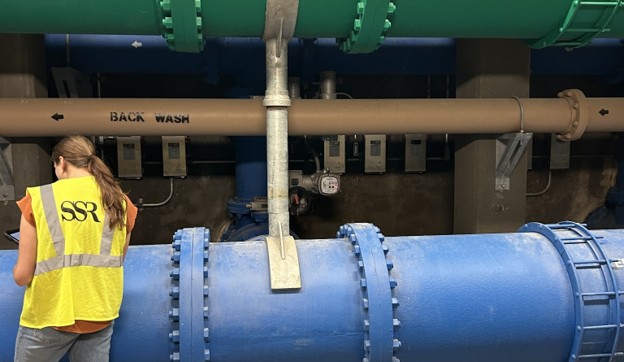
At SSR, our multidisciplinary teams evaluate municipal water and wastewater infrastructure, including treatment plants, pumping stations, and supporting facilities. Depending on a utility’s needs, an assessment can include the following elements:
- Physical condition and remaining useful life. Process, mechanical, electrical, instrumentation and controls, structural, architectural, and plumbing engineers inspect equipment and structures together. Each asset is rated on a five-point scale and adjusted for remaining useful life, so aging equipment is not overlooked simply because it still runs.
- Operational performance and capacity. Hydraulic modeling and biological process analysis show whether a facility can reliably treat its rated flows and where the true constraints lie.
- Safety and regulatory considerations. We identify potential hazards and evaluate compliance with applicable building, fire, and electrical codes, including the National Fire Protection Association (NFPA) 820 standard for wastewater facilities and the National Electrical Code.
- Asset management and capital planning. We develop equipment inventories, condition ratings, and prioritized recommendations that owners can keep using long after the assessment is complete.
- Facility documentation. We compare drawings and records with field conditions and update critical documents where they no longer match.
By working closely with facility operators and pairing their knowledge with maintenance and purchase records, SSR identifies not just what needs attention, but why it matters and how best to address it.
Turning Findings into Actionable Plans
Not every deficiency requires immediate replacement, and not every capacity concern requires new infrastructure. A well-structured assessment distinguishes between issues that can be addressed through maintenance, operational adjustments, targeted rehabilitation, or more substantial capital improvements.
Recommendations are prioritized based on safety, regulatory requirements, operational reliability, equipment condition, remaining useful life, and anticipated future needs. Low-cost quick wins are called out separately so they can be completed right away. For utilities balancing limited budgets with growing demands, this approach directs resources where they provide the greatest benefit.
SSR’s Assessment Experience in Action
Spring Hill Water Reclamation Facility
The City of Spring Hill has experienced rapid growth, and its Water Reclamation Facility, currently rated for 5.0 million gallons per day (MGD), is planned for expansion to 7.5 MGD by 2030, with future plans for 10 MGD. Before expanding, the City engaged SSR to perform a comprehensive condition assessment and performance evaluation to determine what it would take to operate the existing plant effectively at its full rated capacity.
Working closely with plant personnel, SSR collected equipment and condition information in the field and through records review and used it to build an asset inventory in Autodesk Forma. Nameplate photos, operation and maintenance manuals, and other documents are linked directly to each asset. The assets are also linked to selected record drawings, so City staff can open an asset’s information and documentation simply by clicking on it in a drawing.
After years of upgrades, modifications, and expansions, the plant’s electrical drawings no longer reflected its actual configuration. SSR reconciled those records with field conditions and provided updated electrical single-line diagrams, giving staff a reliable resource for maintenance, troubleshooting, and future improvements.
SSR also evaluated operating practices and performed hydraulic and biological process analyses to identify capacity constraints and the changes needed to address them.
The evaluation showed how much can be gained without major capital investment.
- At SSR’s recommendation, plant personnel returned the biological treatment process to its intended operating configuration during the evaluation, restoring the intended flow pattern and resolving a process short-circuiting issue.
- Field measurements found that the weirs splitting flow between the two oxidation ditches were set about half an inch apart in elevation, enough to send roughly 55 percent of the flow to one ditch. A simple laser realignment would correct the imbalance.
- SSR identified piping and control modifications that would allow the influent pump station to convey its rated peak hour flow with one pump out of service.
The recommendations gave the City a prioritized framework for addressing immediate concerns, improving reliability, and planning the expansion. Just as important, SSR recommended developing a plant-wide hydraulics plan before expansion design moves forward, so that legacy constraints are not carried into new facilities.
Murfreesboro Water Resource Recovery Facility
For the City of Murfreesboro, SSR performed a multidisciplinary condition assessment of the 24 MGD Murfreesboro Water Resource Recovery Facility, covering 17 areas, including treatment processes, pumping facilities, structures, electrical systems, and site infrastructure. The assessment is a key part of the preliminary engineering report supporting the City’s National Pollutant Discharge Elimination System (NPDES) permit application and planned expansion to 32 MGD. SSR reviewed the recommended improvements with City staff, who indicated whether each item was needed within 18 months, within five years, later, or not at all. SSR then weighted those priorities by the condition ratings to produce a ranked list of rehabilitation and replacement needs to guide expansion planning.
The Right Assessment at the Right Time
Facility assessments do not have to be tied to a major capital project. For some utilities, a focused assessment of a pumping station, treatment process, or aging electrical system may be all that is needed to develop a practical improvement plan. Others benefit from a facility-wide evaluation that supports long-term asset management, capital budgeting, and grant and loan applications that call for current condition information.
For utilities considering expansion, assessing existing facilities early is especially valuable. Knowing which assets can be retained, rehabilitated, or optimized establishes a reliable basis for design and helps avoid both unnecessary replacement costs and building new capacity on top of old problems.
Common signs it may be time for an assessment include the following:
- A facility struggles to perform as it approaches its rated capacity
- Equipment failures and unscheduled maintenance are becoming more frequent
- Record drawings no longer match what is installed in the field
- An expansion, permit renewal, or major capital project is on the horizon
Let’s Talk About Your Facility
Whether your utility is experiencing operational challenges, developing a capital improvement plan, or preparing for future growth, SSR can help you understand your infrastructure and identify practical solutions.